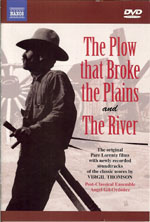
Music composed by Virgil Thomson.
Soundtracks re-created by Post-Classical
Ensemble, Angel Gil-Ordonez, music director. Floyd King, narrator. Recorded in Baltimore, Maryland on 11-12 June 2005. DVD Executive Producer: Joseph Horowitz. DVD Author: Oliver Clemens (K&A Productions Ltd.).
Special Features:
George Stoney on THE PLOW THAT BROKE THE PLAINS and THE RIVER (15:01)
George Stoney on The New Deal, THE RIVER, and Race (6:09)
Charles Fussell on Virgil Thomson (17:35)
Virgil Thomson on Virgil Thomson (audio only, 7:15) -- 1979 interview --
see Important Correction below
The original beginning of THE PLOW THAT BROKE THE PLAINS (3:28)
The original ending of THE PLOW THAT BROKE THE PLAINS (2:56)
Naxos DVD 2.110521
Rating: ***1/2
Also available is the Naxos CD (8.559291)
with the World Premiere Recordings of the Complete Film Scores
by Virgil Thomson performed by the Post-Classical Ensemble --
THE PLOW THAT BROKE THE PLAINS
and THE RIVER
Important Correction:
I want to set the facts straight on one of the Special Features on this DVD which involved my interview with Virgil Thomson.
On the DVD case and insert booklet it is listed as "Virgil Thomson on Virgil Thomson." That is misleading and doesn't provide the complete information.
Actually this is from my interview which took place at the Peabody Conservatory of Music in Baltimore, Maryland. This excerpt is taken from my longer conversation from April 18, 1979 with Thomson, now available from the
American Music Recordings Collection (AMRC CD 0006).
What is most disturbing about this Thomson audio interview is it was used without my knowledge or permission. I had donated a copy of this interview to Yale University for research purposes only, not for commercial release.
DVD executive producer Joseph Horowitz told me he received a copy of my interview from the Oral History American Music (OHAM) archive at Yale. But nobody bothered contacting me for permission. He was led to believe by OHAM that it was approved by them and there was no need to contact me about it. Not true.
Because of the confusing credit identification on the DVD, some reviewers (such as Anthony Thommasini in his NY Times review of February 25, 2007) assumed it was a Yale production. It was not.
All of this could have been avoided if the proper credit was given by OHAM at Yale and I was contacted to grant permission.
Unfortunately, that did not happen.
Update - December 2007:
After consulting with Naxos, I was given credit for
the 1979 Virgil Thomson
audio interview and
it has been added on the back of the DVD case
of their
reissue.
This credit is indicated by an asterisk and is listed in small print at the
bottom of the DVD case.
But it is only available on the reissue copy of the DVD.
-- Roger Hall
DVD Review:
The two half-hour documentary films on the DVD were made during President Franklin Roosevelt's New Deal administration of the 1930s, and written and directed by Pare Lorentz.
Did Thomson prefer one of these two film scores? Yes, he did. He told me in an 1979 interview that he preferred THE PLOW, saying it has "a freshness" that remains more so now than THE RIVER or his later score for Robert Flaherty's LOUISIANA STORY, for which Thomson received a Pulitzer Prize.
On the DVD you have the choice of hearing each film with the original soundtrack and narration or the re-created soundtrack by the Post-Classical Ensemble. Viewers should be warned that the original version of THE PLOW THAT BROKE THE PLAINS begins with selected visuals and without any music or narration on the soundtrack. The music is heard right away on the re-created version, with the narration spoken by Floyd King. He reads it as if he were reciting a Shakspearen soliloquy and that's probably because he has acted in so many plays. But his reading doesn't suit the simple directness of the film narrations and visuals. The original narrator, Thomas Chalmers, is much more effective because he is more understated in his delivery.
Considering their age, the original soundtracks conducted by Alexander Smallens still sound decent,though a bit muddy. The re-created soundtracks by The Post-Classical Ensemble as conducted by Angel Gil-Ordonez sound much better and includes restored music not on the original soundtrack.
Thomson's film scores are excellent examples of making a great impact with a small ensemble. He also makes use of folk instruments, such as the banjo and guitar. Plus, he incorporates familiar tunes as well, including several popular songs such as "I Ride an Old Paint" and hymns like the "Doxology (Praise God from whom all blessings flow)" in THE PLOW, and "How Firm a Foundation" in THE RIVER. Thomson and also Pare Lorentz obviously felt strongly that using hymns prominently in both scores would make a strong impression with the audiences at that time.
The DVD credit lists an excerpt from a hymn incorrectly titled: "The Restoration." The correct title should be: RESIGNATION (My Shepherd will supply my need) and is heard in THE RIVER score. In my interview, Thomson told me he found this beautiful folk hymn in The Southern Harmony of 1835.
The video interviews with both George Stoney and Charles Fussell are worth watching.
Stoney has two segments. He talks about how these Farm Security Administration films were extremely popular when shown to the audiences everywhere they were exhibited, and Thomson's use of tunes such as the Doxology. Also, he speaks about The New Deal and the race problems at that time.
Fussell discusses Thomson's composing style and tells a few humorous anecdotes about his friend. Mention is made by Fussell of what he calls the Thomson and Copland "friendly rivalry" with their film music. Joseph Horowitz, who looks very awkward sitting next to Charles Fussell, interjects too many of his own pronouncements, such as overstating the importance of Thomson's film scores compared to Copland. Surely the Thomson scores were important and perhaps influential, but they did not have the same impact as Copland's film scores, such as OUR TOWN. Nevertheless, the use of smaller instrumental ensemble employed in the Thomson film scores was not at all like the larger Hollywood sound of such composers as Steiner, Korngold or Newman in the 1930s.
The two films themselves look clear and sharp and the soundtracks offer a choice of 2.0 Dolby Stereo, 5.1 Dolby Surround, or 5.1 DTS Surround. There is also the original beginning and ending of THE PLOW available on separate menus.
The biggest defects of this DVD are the overblown narration by Floyd King, the lack of accurate identification for the Thomson audio interview, and the confusing DVD menus for choosing the original soundtrack or the re-created one. You must click the "Enable" or "Disable" button to find the film soundtrack you want to hear.
Overall this is worthwhile for anyone wishing to see what US propaganada was like in Franklin Roosevelt's New Deal of the 1930s.
But more importantly, these films provide examples of how a first time filmmaker like Pare Lorentz could work effectively with a first time film composer like Virgil Thomson. What might have been just government sponsorsed films were turned into highly artistic achievements by both Lorentz and Thomson. The music especially has received much respect and admiration.
This DVD is especially recommended for educational use in schools or for discussion groups.
These two documentary films provide outstanding examples of 1930s Americana film music.
--Roger L. Hall, December 2007
Please help support
Film Music Review
Order your copy of this popular book --
.jpg)
Film Music Review (Home Page)










.jpg)