Massachusetts music
Music from Stoughton
Lectures and Workshops


New England Composer Series No. 1:

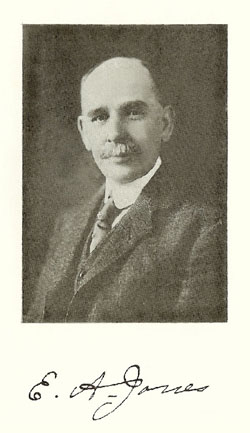
Edwin A. Jones

Born: Stoughton, Massachusetts, 28 June 1853
Died: Stoughton, 9 January 1911

The distinguished writer,  Edward Everett Hale, author of The Man Without a Country, called him "one modest man who knows the power of music."  This modest man, from a rural Massachusetts town south of Boston, is a composer well worth
re-discovery.  

His full name was Edwin Arthur Jones but like J.S. Bach (whom he greatly admired), he preferred to be known as E.A. Jones.

Following his studies at the New England Conservatory of Music in violin, organ and harmony, E.A. Jones entered Dartmouth College in 1872. While there he became Captain of the college baseball team, one of the editors of the college newspaper, and Director of the Dartmouth Glee Club. He graduated in 1876 as Class President.

While attending Dartmouth College, Jones composed several exceptional glee club choruses, including two from 1874:"Praise Ye the Lord" and "Blessing and Glory." To hear the first chorus, click on the link in the box using Real Player:


In 1872, Jones was one of the hundreds of violinists who played at the World's Peace Jubilee and International Music Festival at Copley Square in Boston. The special invited guest at the Festival was Johann Strauss II from Vienna, known as "The Waltz King." For this Festival, Strauss arranged a new waltz he called, "Jubilee Waltz." To show his gratitude, he quoted "The Star Spangled Banner" at the end of his waltz.      

E.A. Jones  went to Baltimore after graduating from Dartmouth College. He may have been paying homage to Johann Strauss when he finished his first major instrumental composition -- a delightful piece for solo piano titled:The Farewell Waltzes published in Baltimore in 1874. This first published composition by Jones was given the first modern day performance in 1986 at a concert in Lexington, Massachusetts
[a recording is in the NEMA library].

Six years later, in 1880, his First String Quartet in F Major ( Op. 13) was performed at the Peabody Concervatory in Baltimore,
where it was well received.  

He then returned to his home town of Stoughton, Massachusetts.

His Second String Quartet, titled Prelude and Fugue in G minor (Op. 22), was first performed in 1889 by the Kneissel Quartet in the Gardner Home at 152 Beacon Street in Boston. This string quartet is dedicated to Mrs. J.L. (Isabella Stewart) Gardner [a recording is available in the NEMA library]. Other composers represented on that concert program at the Gardner home included Edward MacDowell and Horatio Parker.

Thanks to the efforts of E.A. Jones, the Stoughton Musical Society was the only musical organization to perform early American choral music at the World's Columbian Exposition in Chicago in 1893.
The Jones orchestra accompanied the chorus of 100 singers
of the Stoughton Musical Society.

As violinist and organist, Jones was an admirer of the Baroque music of J.S. Bach and G.F. Handel, and composed two large scale choral works: a cantata and an oratorio.

Completed in 1881, his cantata Song of Our Saviour (Op. 14), was his crowning achievement. This work is for four soloists, chorus, organ and orchestra. It received its world premiere over one hundred years later in 1992, conducted by Dr. Raymond E. Fahrner [a recording was made at that time and is now in the AMRC library]. Click the link in the box at right to hear a Trio for soprano, alto, tenor soloists, organ and orchestra from this dramatic 1881 cantata.

The cantata was based on an earlier choral piece, The Nativity Hymn, one of only four works to receive honorable mention in 1879 in the Cincinnati College of Music competition, judged by the distinguished American conductor,Theodore Thomas.

The other major choral work by Jones was his oratorio, Easter Concert (Op. 28), published in 1890 in a piano-vocal score by White-Smith Music in Boston. The oratorio is modeled on Handel's Messiah and is in three sections, ending with a impressive fugal movement for
solo quartet and chorus.  

The first modern day performance of this Jones oratorio, edited and conducted by Roger Hall, was performed by the Old Stoughton Musical Society Chorus in 1981 . The work was performed again three years later. Both performances were from the piano-vocal score.
Unfortunately, the orchestral parts are lost.

Several selections from the Jones cantata and oratorio are listed
on the Top 40 at:

New England Music Archive (NEMA)

Besides his two large choral works, Jones also composed many shorter choral pieces and songs, some chamber music, but only a few orchestral works, which seems strange since he had his own orchestra. A photo showing his orchestra of 20 musicians is included in the pamphlet,
E.A. Jones: His Life and Music.

Jones was a member of the two choral societies in town:
The Old Stoughton Musical Society
 (founded in 1786 and now the oldest choral society in the United States) and The Musical Society in Stoughton (founded in 1802, disbanded in 1982). For the OSMS Centennial in 1886, Jones was the lead violinist and director of the orchestra.

He also held a weekly musicale of chamber music with his musician friends at his home in Stoughton.

Besides his musical activities, he was also remembered for his civic leadership as school committee member and Superintendent of Schools, trustee of the public library, President of the Fortnightly Club, and
Secretary of the Chicataubut Club.

In 1892, Jones designed the Stoughton Town Seal -- possibly the only one in the United States with a historical music symbol.

Today, there is a school in Stoughton named after him, just across the street from where he lived at the corner of Pierce and Walnut Streets.

E.A. Jones died on 9 January 1911, at the age of 57.


The above material was compiled from these publications written by Edwin A. Jones biographer and musicologist, Roger Hall:

  • E..A. Jones: His Life and Music (1984)-- includes a catalogue of his works.
  • "Jones, Edwin Arthur" in
    The New Grove Dictionary of American Music, Vol. Two
    (Macmillan Press,1986)
  • Music in Stoughton: A Brief Survey (1989)
  • Singing Stoughton: Highlights from America's Oldest Choral Society (1985)


Recorded Tributes

There are two CD-Rs available of music by this Stoughton composer, compiled by musicologist Roger Hall:

  • E.A. Jones : His Life and Music -- Interviews with two women who knew E.A. Jones, his Prelude & Fugue in G minor for pipe organ, Trio for Strings, and excerpts for soloists and chorus from the first modern performance of his oratorio,
    Easter Concert,
    in 1981.
  • Music by E.A. Jones -- Prepared for the 150th anniversary of the birth of Edwin Arthur Jones in 2003, this CD-R contains a sampling of his music, including an organ prelude and fugue, two glee club choruses composed at Dartmouth College, his String Quartet No. 2
    (first performed at Isabella Stewart Gardner's home in Boston), and
    excerpts from the cantata, Song of Our Saviour (1881).

To order these CD-Rs, go to the

AMP Store

To inquire about the music of E.A. Jones, write to:

New England Music

See also this Wikipedia entry:

Edwin Arthur Jones


New England Music Recordings

Best of William Billings

Music by George Whitefield Chadwick and Edwin Arthur Jones

New England Music Archive [NEMA]

Singing New Englanders: From The Pilgrims To The Shakers

New England Songster

New England Song Treasury


Help support the mission of

American Music Preservation.com

Use this handy Search for your purchases...

  Enter keywords...


Return to top of page


Contact
 

© 2006-2008 PineTree Productions. All Rights Reserved.