
 |
 |
 |
 |
 |
 |

Tales of the Tune Man
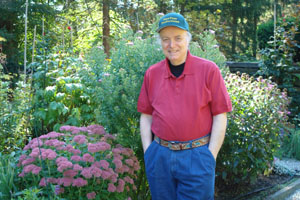
As told by songwriter,
Roger Lee Hall
Tale No. 1: "I'm So Lonesome I Could Cry" -
Remembering of My Dad and ElvisTale No. 2: "Oh, How I Hate To Get Up In The Morning" -
Memories of EMA and OHEKA Castle
Please help support this website
Order your Books, CDs, DVDs from the
Store
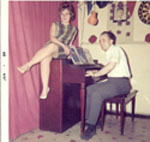
Because of his studies of all kinds of tunes (folk, pop and classical),
Roger Lee Hall has been called "The Tune Man."For permission to reprint or quote any of the tales on this page
for publication in a book or a web site,
write to him at
Tale No. 1:
"I'm So Lonesome I Could Cry"-
Remembering My Dad and Elvis
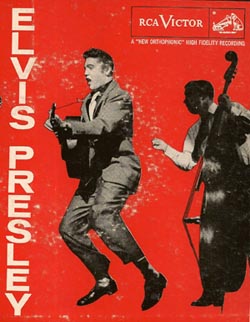
Elvis Presley was born at 4:25 a.m. on January 8, 1935. What is even harder to believe is a very special milestone in my own family history. My dad, Russell, was born in Winchester, Kentucky one hundred years ago today. So he shares the same birthday with Elvis. What a fortunate coincidence!
1902
In this year, my dad was born, and the Texas oil company (Texaco) was founded and Theodore Roosevelt became the first American President to ride in an automobile. I mention these facts because dad was always proud of his cars and would keep them clean and bright. The same was true for Elvis with all those Cadillacs he bought for his family and freinds.
What songs were popular the year my dad was born in 1902?
Here are a few of them:"Bill Bailey, Won't You Please Come Home?" (Hughie Cannon)
"In the Good Old Summertime" (George Evans-Ren Shields)
"Under the Bamboo Tree" (J. Rosamond Johnson-Bob Cole)
"The Entertainer" (Scott Joplin)
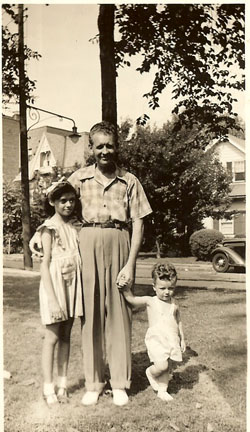
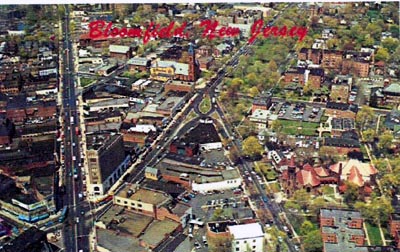
My older sister, Dad, and me in Bloomfield, NJDad spent most of his life working as a waiter in New York City and as a machinist at Westinghouse in Bloomfield and Edison in Orange, New Jersey.
1952
Fifty years after dad was born, our family was split up and I didn't see him again for a few years. The family separation was especially hard on me. But I took some comfort remembering my dad listening to music on the radio and in the bars he went to.
Even though dad never was a big fan of Elvis, they did share one connection. Both grew up listening to country music, or "hillbilly music" as it was commonly termed at that time.
The best known hillbilly or country musicians of the 1940s and 1950s included: Roy Acuff, Eddy Arnold, Red Foley, Bill Monroe, Hank Snow, Ernest Tubb, and Hank Williams (my dad's favorite singer). Was Elvis aware of these musicians? You bet he was. He worked with Hank Snow in his early career before he became a superstar. Some of Elvis's songs reflect his interest in other kinds of music.
On the essential CD, The Sun Sessions, Peter Guralnick provides fascinating observations on the early songs Elvis recorded.
Here is what Guralnick writes about one of the most soulful early recordings by Elvis:
"Listen to 'Blue Moon,' the Rodgers and Hart ballad which Billy Eckstine recorded in 1948 in a satin-and-silk version with which Elvis must have been familiar (Eckstine was one of his favorite singers). What is he doing to this song? What is that eerie falsetto wail? The first time I heard this cut on Elvis's debut album in 1956 when I was 12 years old, I was outraged! I must have taken it as a betrayal of rock 'n' roll. Now I hear it somewhat differently: now it seems touching to me, a ghostly echo from the past, though whose past - Elvis' or mine - I'm not really sure."
Unlike Guralnick, I wasn't outraged when I first heard Elvis sing "Blue Moon." I liked the recording then and still like it today. That "eerie falsetto wail" (as Guralnick calls it) is unique in the Elvis recorded archive - a gutsy, no holds barred rendition of this great Rodgers & Hart ballad.
1961
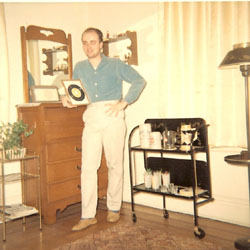
While stationed in the U.S. Army, where Elvis had served just a few years before, I wrote my first song, "Dream World." When I wrote the song I was paying homage to the Elvis huge million-selling hit song, "It's Now or Never."
I made a demo record with a group I belonged to called Jake & The Potpourris. We hoped that my song would catch someone's ear and would be released commercially but that never happened. Unlike Elvis, who could record any song he wanted, my wish to have my "Dream World" song released commercially has been only -- a dream.
1974My dad died this year at the age of only 72, just three years before Elvis.
1993
When I premiered my new radio show "IN THE MOOD"on August 16, 1993, I played "Blue Moon" in memory of Elvis, who had died on that day in 1977. I also played "Poor Boy" from LOVE ME TENDER, because Elvis started out that way when he lived first in Tupelo and then later in Memphis.
And what about my dad's favorite singer, Hank Williams? Did Elvis record any of the Hank Williams songs? He sure did.
In the excellent RCA/Time-Life Music series, The Elvis Presley Collection, there are double discs to illustrate the broad range of Elvis's talent. On the country CD there are a few songs about my dad's home state: "Blue Moon of Kentucky" and "Kentucky Rain."
There's also two songs by Hank Williams. On the first CD is: "I'm So Lonesome I Could Cry" - from a live appearance in 1973. The other song is on the second CD and is one of the most popular Hank Williams songs: "Your Cheatin' Heart."
When Elvis introduces "I'm So Lonesome I Could Cry," he says:
"I'd like to sing a song that's probably the saddest song I've ever heard."
That song was a favorite of my dad. Another Williams song he liked was "Cold, Cold Heart."
Elvis was a singer I've long admired for his deep feelings for the music he recorded. I think he has been misrepresented in the media. I had the pleasure to work with the Cleveland disc jockey who introduced Elvis on national TV back in January of 1956. The first song sung by Elvis was "Shake, Rattle and Roll/Flip, Flop and Fly" and not "Heartbreak Hotel" as many have written.
Elvis is usually portrayed as just a swivel-hipped rocker or the overweight drugged-up lounge lizard.
He was actually a unique singer who could sing almost anything, at least in the early years before he was sanitized for the many Hollywood films he made.
I believe Elvis was best when he sang love ballads and gospel songs. He sang them with more sensitivity and depth of feeling. His recordings of "Amazing Grace" and "How Great Thou Art" are among the best by any pop singer I've heard. I've never been a huge fan of his more famous upbeat rockin' numbers, like "Hound Dog" and "Jailhouse Rock." But even his uptempo recordings are well done. He put all he had into his recordings.
So in memory of my dad's 100th birthday and for Elvis (who died twenty-five years ago), I'll say...
"I'm so lonesome I could cry" when I think about their goodness and joy they brought to my life.
January 8, 2002
For more information about Elvis in the 1950's, go to:
Tale No. 2:"Oh, How I Hate To Get Up In The Morning"
Memories of EMA and OHEKA Castle
Introduction
This is a tale of E.M.A. and OHEKA.
What do these abbreviations mean?
E.M.A. stands for Eastern Military Academy.
And OHEKA is the castle named after Otto Hermann Kahn and where E.M.A. was located for thirty years from the 1940s to 1970s.
I was thrilled to go to E.M.A. in the 1950s.
Let me explain...
As a longtime film buff, I was pleased to discover several views of Otto Kahn's castle shown in the "News On The March" footage at the beginning of the Orson Welles classic, CITIZEN KANE. The film's story is supposedly based on the life of newspaper tycoon William Randolph Hearst. But it could also apply to Otto Hermann Kahn (1867-1934), a wealthy financier who had a love of opera and, like Hearst, built his own castle.
I don't know if Kahn had a mistress like William Randolph Hearst, although there have been rumors about his eye for beautiful showgirls, and he did invite them to his Long Island castle where he lived the high life.
Kahn was known as "King of New York" in the 1920's, because of his major support of the Metropolitan Opera and other philanthropic activities. He also championed famous musicians like songwriter George Gershwin, opera singer Enrico Caruso, singer Paul Robeson, and conductor Arturo Toscanini.
But I didn't know anything about his past work or even his name. The story we heard as EMA cadets was that the castle had been built by Aly Kahn, one of movie star Rita Hayworth's husbands. It was only many years later, after I did some research, that I learned about Otto Kahn and his castle. Seeing those quick stills of Kahn's castle in CITIZEN KANE, reminded me of how wonderful it was to actually go to school and live there for a few years.
One summer afternoon the guy known as "King George" (my mother called him that because she said he liked to be treated like royalty) stopped off at a bar with me (I was only 10 years old at the time). Right away he made a pass at a buxom blonde who was there at the bar. I went over to play some shuffleboard. He called me over and asked me to dance with this blonde. For a young boy with raging hormones, dancing closely with such a big bosomed blonde was a thrill. I looked up and there were her big boobs staring me right in the face! Wow, what a sight! I remember the song that was playing on the jukebox while we were dancing was Jo Stafford's haunting "You Belong to Me." K.G. wanted me to dance with that blonde so he could charm her to "belong" to him...in bed. He quickly took me home, then went back to the bar to meet this blonde -- presumably for sex. I hated having to be with K.G., who during the week was sober and had a good paying job with Pfizer. But on weekends he would come to our apartment and get totally smashed and drive me around in his blue Pontiac. He also drove my mother and me to Eastern Military Academy while he was completely drunk. What a waste he was!
Eastern Military Academy
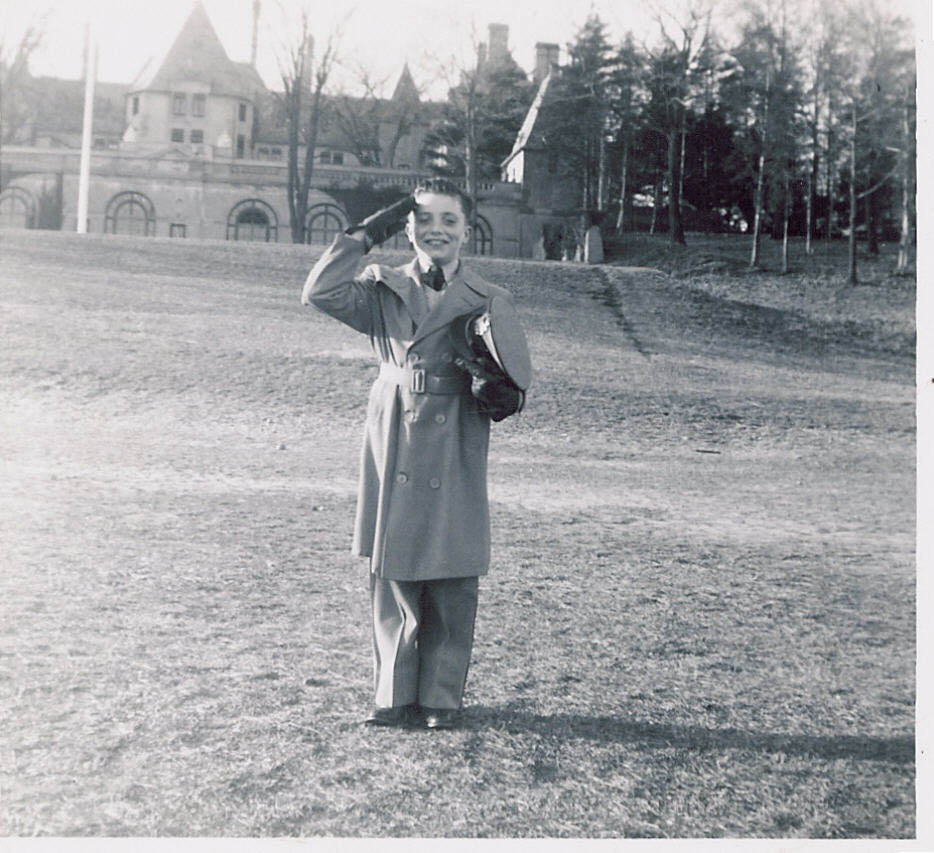
I attended E.M.A. from 1952 to 1955. While there I learned discipline and also got a good education too.
For me, those were the best years of my childhood.
I loved being at that school.When I arrived at E.M.A. in September of 1952, I was pleased to see they had a small number of students in each class and very good teachers. My favorite was Mr. Lewis Brody, who was a very enthusiastic teacher. He called me his "jolly one" because I smiled so much. That was mainly because I was glad to be there instead of at home with an unstable mother.
Thanks to Mr. Brody and other teachers, I learned to improve myself. From the military training there, I learned discipline and leadership. I had lots of fun too. And most important to my later music career, I learned how to sing.
It was there that I sang for the first time in the Lower School Glee Club. I was in the 6th grade. Our music director was Willard Young, and he also led the Senior Glee Club. We spent most of our time rehearsing for music programs during the school year and enjoyed it a great deal.
One of the songs I remember singing was "My Buddy"-- a sentimental song that had been recorded by Bing Crosby. Some of the cadet glee club members made fun ot it but I liked the song.
We had many drills and parades. My favorite march was Bagley's "National Enblem" which made me smile every time I heard it. Of course that's the march with the joke line: "And the monkey wrapped his tail around the flag pole." I didn't mind the marching although sometimes the weather wasn't the best. At least we didn't march in the rain or snow like the regular US Army.
I also remember the commencement exercise in June, held under the beautiful double row of trees near the Water Gardens.
In his book, Raising a Fallen Treasure: The Otto H. Kahn House, Robert King criticized the military academy for having little use for the formal gardens. He claimed that the military school's main purpose was
"to train boys into soldiers, and manicuring the magnificent gardens of Frederick Law Olmstead did little to facilitate those ends."That's not totally accurate. The school did try to keep the grounds neat and clean, but didn't have the money for landscaping and most of the once beautiful gardens were neglected and the fountains were never filled with water. Still, the row of trees used for the June commencement exercises was quite a lovely spot. The interior of Otto Kahn's massive castle was pretty much intact. Naturally changes had been made to accommodate the needs of the military academy.
One of the most extreme alterations was to transform the once ornate Ballroom, into a gymnasium with scoreboards hanging down and quilted floor mats stuffed into the huge fireplaces. I remember the room was in need of repair, with broken plaster and cracks on the ceiling. That didn't seem to matter much at the time because it was a room used for all the big school occasions. And the view through those glass doors was quite something to behold. As a youngster of only 11, I almost won the all-school spelling bee there, with Mr. Bolchoz as moderator.
Thanks to my good grades, I was the only Lower School kid invited to attend an Upper School old-fashioned square dance. I even got to wear my western outfit, which put me in mind of my Hopalong Cassidy days. Other events held in the Ballroom included visiting speakers and variety shows. I was in one of them as a member of a minstrel show. With all these activities, it was a fun place to go to school. I didn't want to go home on vacations.
Going to school there was like living in a miraculous fantasy castle like at Disneyland in California-- this was years before Disney World had been built in Florida.
Sadly, after I left in September of 1955, I didn't see the school or my E.M.A. friends again.
Yet I kept hoping someday to return there and
see that beautiful entrance staircase again...
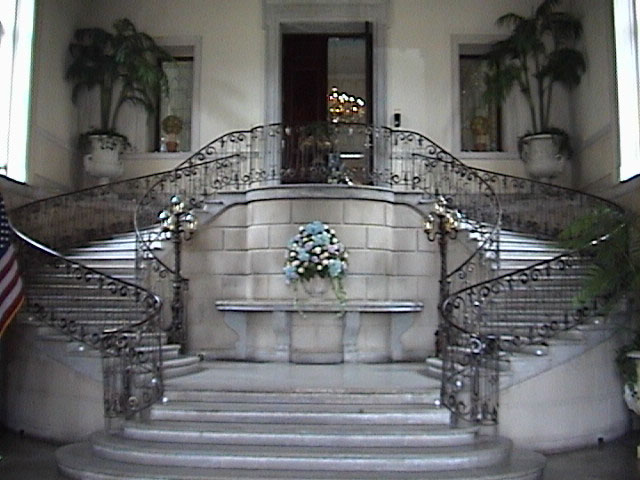
Otto Kahn's Castle
I read in Robert King's book that after E.M.A. went bankrupt and closed down, the castle was vacant and almost completely destroyed by gangs of young vandals. It was badly burned throughout and every one of the many windows were broken.
But Kahn's magnificent castle refused to die.
He had wisely built his castle to be fire protected.
Fortunately local developer Gary Melius purchased the castle in 1984 and proceeded to carefully restore it.
After spending millions on cleaning, rebuilding and restoration, much of the castle has been restored to its original elegance. I never thought I would see it again.
Then I joined at the Friends of OHEKA.
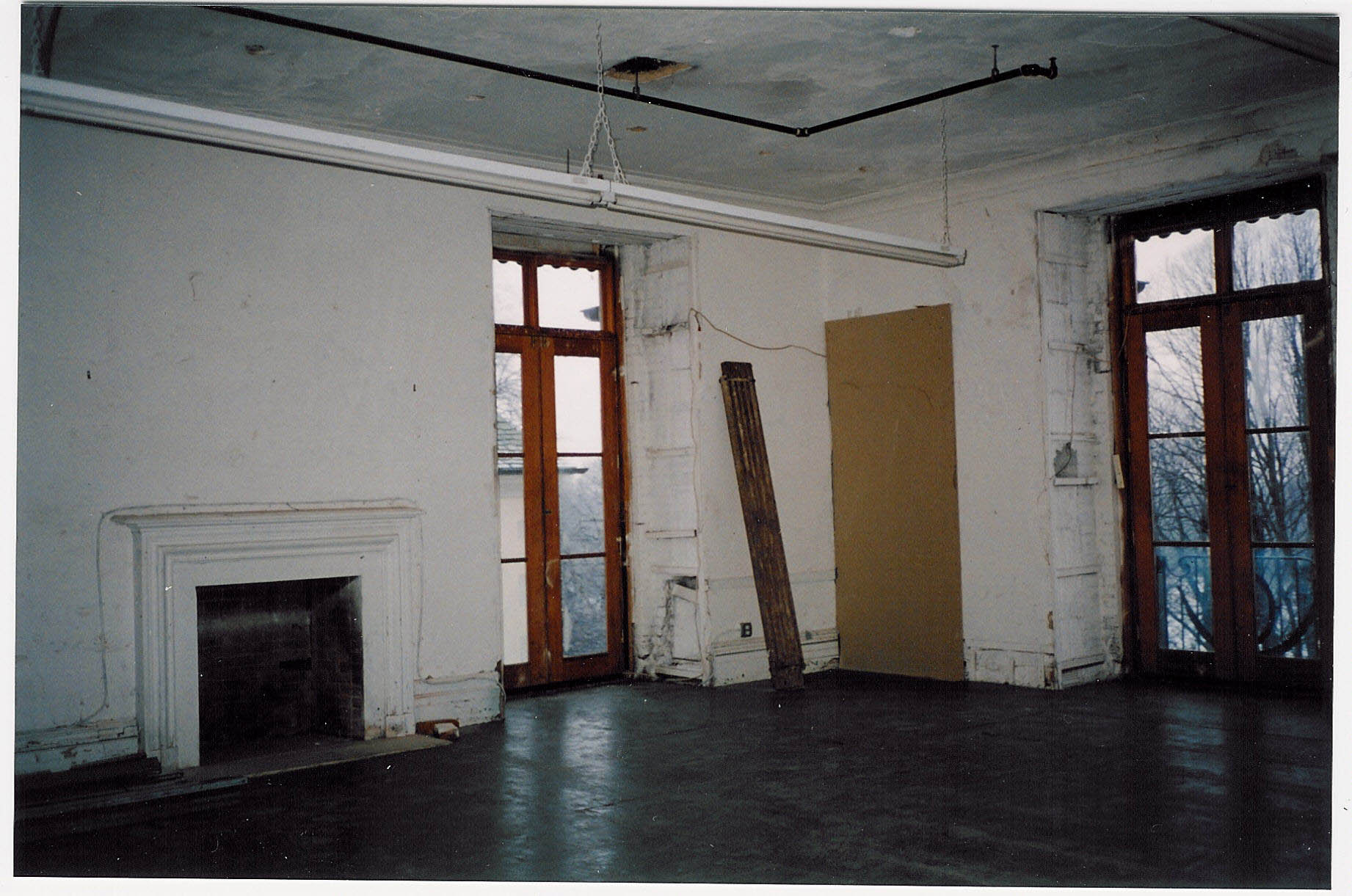
After the Friends meeting, thanks to the kindness of Ted Owens and Gary Melius, I went up to see the second floor room where I had lived while at E.M.A. Even though the room was empty and still in need of repair, the fireplace and mantel were still there as I remembered them. How thrilled I was to see that room again!
I took a photo to remember it because the next time I might see it the room would look much different...
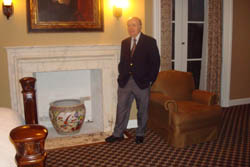
And here is how that same fireplace area looks after the beautiful restoration...
I sometimes think back to those student days when we used to listen on my Emerson portable radio to such scary programs as "Inner Sanctum" and "Suspense." At that time there were about a dozen of us living in that one large room. It was divided into small cubicles, with two or three boys in each one. I didn't mind the crowded conditions at all. I can remember looking outside through the enormous glass doors in the room. What a view from there! I could look out the rear of the castle and see the private golf course with its well manicured fairways. During one especially harsh winter, I remember trying to walk through waist high snow on the golf course. It was the kind of foolish fun we did as young boys there.
Later on, I moved to a different room with my school pal Ed Steele, who played trombone in the school band. Believe it or not, we were asked to look after the younger kids. We were only in the 6th grade ourselves! We worked with the Housemother to keep the uniforms neat and the shoes shined. She was a rather plain looking woman but had grabbed the attention of one of the equally plain looking male teachers. I remember one particular incident.
One of those damaging hurricanes came roaring by in 1954. All the power went out at the castle. Since my mother wasn't able to come and get me, I had to stay there. Walking down the halls of OHEKA by canldelight was like being in one of those creepy old Hollywood horror movies. But I wasn't really scared because the castle was my safe home. Due to the lack of refigeration, we were given huge bowls of ice cream and other goodies to eat. During this power outage there was a party for all the teachers and staff. When the Housemother came back to her room I was sleeping just across the hallway. I happened to wake up and noticed that her male teacher friend went into the room with her. A little later, I heard some loud talking and then something hitting the floor. It was the male teacher! The door opened and he came rushing out holding his face. I guessed she had smacked him for putting the make on her and she didn't go for it.
Because of our work with the Housemother, both Ed and me were given gold medals for "good conduct." I also received a silver medal for second highest academic standing in the entire Lower School (grades 1- 6). I was very proud of those medals. But my mother was more concerned about the politician who mispronounced my name at the commencement exercises. He called me: "Robert Hall" - probably thinking of the well known clothing store. In any case, my mother went on and on about his mispronounciation, instead of being pleased with my medals. It was quite a disappointment for a young kid like me. The next year I was yanked out of EMA and went to public school, where I was very unhappy.
I didn't return to my fantasy castle until 45 years later.
I'll always remember those great years spent at OHEKA -- the second largest residence ever built in America with its ornate architecture and 127 rooms which had been altered to suit the needs of the school.
Eastern Military Academy was my home away from home
and my salvation.I'll never forget living in Otto Kahn's magnificent castle.
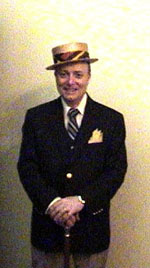
Musical Guest at OHEKA Castle
On Thursday, June 10, 2004, the annual Garden Party was held by the Friends of OHEKA. The event was given mainly to celebrate the 20th anniversary of Pam and Gary Melius's restoration of OHEKA Castle.
Friends President Ellen Schaffer announced that I was not only the featured singer who would perform a few Gershwin songs for the Garden Party audience, but I was also a former E.M.A. cadet who had come back to his former home after 50 years. As I looked around the grounds at OHEKA, I remembered how it used to look when I was attending EMA, especially the commencement exercises held there.
In the 2004 OHEKA Garden Journal, I wrote a story about my experiences. This is now available on a new DVD titled:
Links
To read about the life of the castle's owner, see
For information about OHEKA castle,
go to this website:
Read more at
Memories of OHEKA and Eastern Military Academy
Musical Memoirs
These are eight volumes of Memories and Music written by Roger with his stories and favorite music, including some of his own songs and here are some of them:
"Dream World" -- Songs, Poems and Stories
PTME 1002
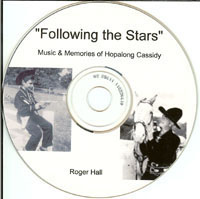
"Following the Stars" -- Music and Memories of Hopalong Cassidy
PTME 1008
"Peace-Lovin' Blues" -- Raised on Rock n'Roll
PTME 1001
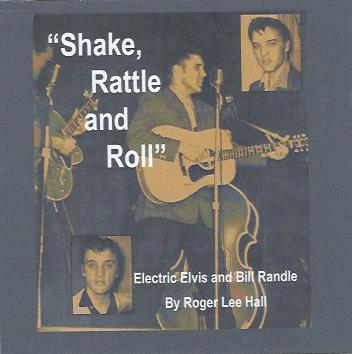
"Shake, Rattle and Roll" -
Electric Elvis and Bill Randle
PTME 1049
"You Are My Sunshine" --
Memories of Bloomfield, 1940s-1960s
PTME 1015
Tune Man's Music
For a list of available music and publications written by The Tune Man,
clcik these links:
Tune Man Speaks
For a list of available music programs presented and performed by The Tune Man, click on this link for
These are other tune lists on this American Music Preservation website:

© 2020 PineTree Productions. All Rights Reserved for original pictures and writing on this website.